
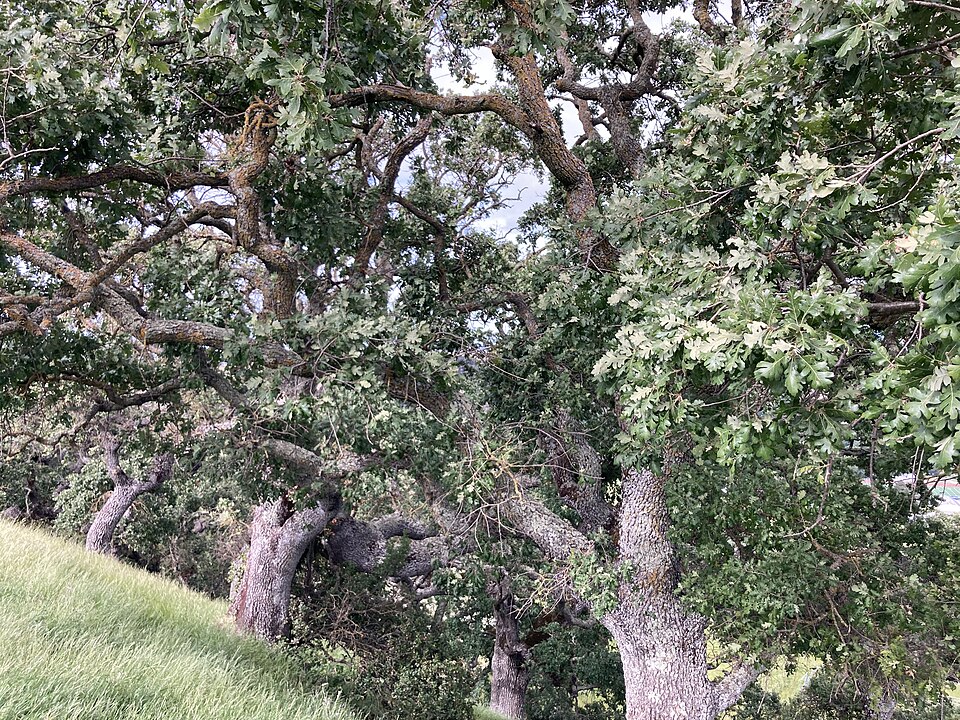
Valley Oak
Quercus lobata
California's largest oak and a keystone of the Central Valley, with deeply lobed leaves and dramatic spreading or weeping limbs on old trees. Adapted to summer drought, it declines under lawns and irrigation; sudden oak death and the cynipid 'oak apple' galls are regional concerns, and many heritage valley oaks are protected.
Field reference
Family
Fagaceae
Growth rate
Moderate
Mature size
40–100 ft tall, 40–70 ft spread
Hardiness zone
7–10
Soil preference
Deep valley-floor soils with summer-dry surface; intolerant of summer irrigation over the roots
Sun
Full sun
Pruning window
Mid-summer (dry season) to limit oak-borer and disease spread
Wood properties
Heavy, strong white-group oak (~0.63 SG) with massive, far-spreading limbs. Big horizontal scaffolds carry enormous cantilever loads — rig long laterals with generous margins.
Native range
Endemic to California, in interior valleys and foothills below about 2,000 ft
Green weight
60 lb/ft³
Pests & diseases to watch
Spongy Moth (formerly Gypsy Moth)pest · High severity · peak Caterpillars feed and defoliate May–June; egg masses laid mid-summer overwinterPowdery Mildewfungus · Low severity · peak Late spring through fall, worst in humid, shaded, crowded conditionsArmillaria Root Rotfungus · High severity · peak Decline visible in summer drought stress; honey mushrooms appear in fall
Common questions
Why shouldn't I water a mature valley oak?
Valley oak is adapted to dry summers and is highly susceptible to Phytophthora and Armillaria root and crown rots when the soil near the trunk stays wet. Keep lawns, irrigation, and fill well away from the root zone of established trees.
What are the round, apple-like balls on my valley oak?
Those are oak apple galls, made by tiny cynipid wasps. They are harmless to the tree and need no treatment despite their size and abundance in some years.
Related species in Fagaceae
Tree Nerd Academy
Ready to sit the ISA Certified Arborist exam?
Video curriculum, flashcards, and exam-sim built by working arborists.