
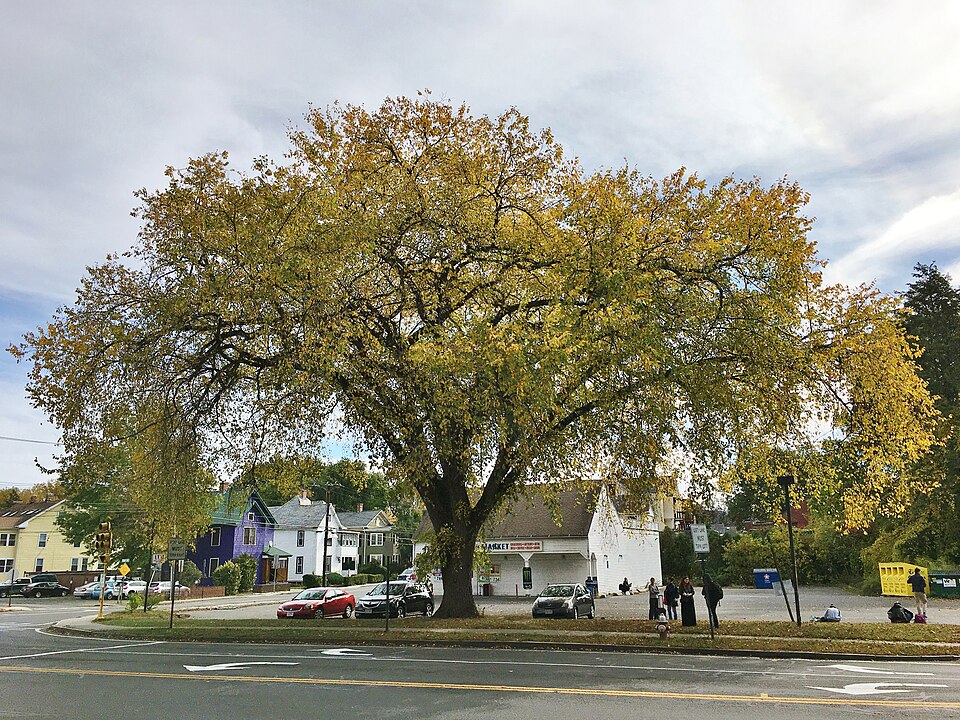
American Elm
Ulmus americana
The iconic American shade tree with a graceful vase-shaped canopy, devastated across the continent by Dutch elm disease. Prune only in the dormant season to avoid attracting the bark beetles that vector the fungus. Disease-resistant cultivars now make replanting viable.
Field reference
Family
Ulmaceae
Growth rate
Fast
Mature size
60–80 ft tall, 40–70 ft spread
Hardiness zone
2–9
Soil preference
Wide range; tolerates wet, dry, and compacted urban soils
Sun
Full sun
Pruning window
Dormant season only (mid-winter) to deter elm bark beetles
Wood properties
Tough, interlocked-grain ring-porous wood (~0.50 SG) that is very hard to split. The classic vase form has strong wide unions but heavy, long lateral limbs.
Native range
Eastern and central North America, Nova Scotia to Florida and west to the Rockies
Green weight
54 lb/ft³
Pests & diseases to watch
Dutch Elm Diseasefungus · Severe severity · peak Symptoms appear late spring through summer; bark beetle vectors active spring–fallAsian Longhorned Beetlepest · Severe severity · peak Adults active and emerging July through OctoberAnthracnosefungus · Moderate severity · peak Spring, during cool, wet, rainy weather at and just after leaf-outBacterial Leaf Scorchdisease · High severity · peak Symptoms most visible mid-summer to fall (July–October)Cankerworm (Inchworm)pest · Moderate severity · peak Larvae feed and defoliate in spring (April–May) as leaves expand
Common questions
Why should I never prune my elm in summer?
Fresh summer wounds release volatiles that draw elm bark beetles carrying the Dutch elm disease fungus. Confine pruning to the dormant season and remove dead wood promptly.
Are there elms that resist Dutch elm disease?
Yes — cultivars such as 'Princeton', 'Valley Forge', and 'New Harmony' show strong resistance and restore the classic vase form for street plantings.
Related species in Ulmaceae
Tree Nerd Academy
Ready to sit the ISA Certified Arborist exam?
Video curriculum, flashcards, and exam-sim built by working arborists.