
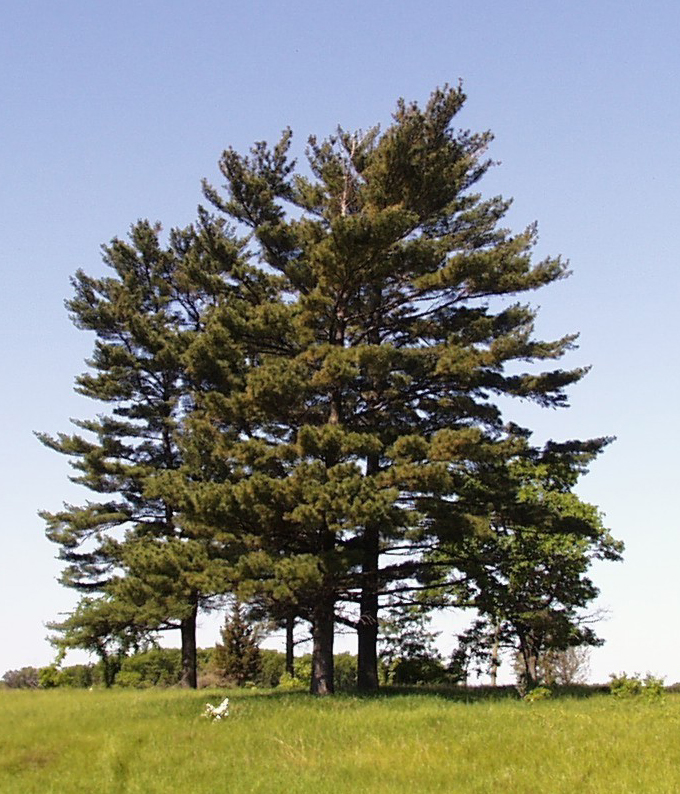
Eastern White Pine
Pinus strobus
The tall, soft-needled 'king pine' of the Northeast, with five needles per bundle and a graceful, layered form. Sensitive to road salt, air pollution, and de-icing spray, often showing winter needle browning. White pine weevil deforms leaders, and white pine blister rust affects it where currants grow nearby.
Field reference
Family
Pinaceae
Growth rate
Fast
Mature size
50–80 ft tall, 20–40 ft spread
Hardiness zone
3–8
Soil preference
Moist, well-drained, acidic soils; intolerant of salt and pollution
Sun
Full sun
Pruning window
Late winter to early spring; light shaping only on candles in spring
Wood properties
Soft, light, straight-grained low-density wood (~0.35 SG); easily worked but weak. Whorled branching and soft, flexible limbs — easy to climb but brittle when frozen.
Native range
Northeastern North America, Newfoundland to Georgia along the Appalachians
Green weight
36 lb/ft³
Pests & diseases to watch
Southern Pine Beetle (Pine Bark Beetle)pest · Severe severity · peak Multiple generations spring through fall; outbreaks peak in summer droughtsAphidspest · Low severity · peak Populations build in spring and early summer, with flushes through the seasonArmillaria Root Rotfungus · High severity · peak Decline visible in summer drought stress; honey mushrooms appear in fall
Common questions
Why did my white pine's needles turn brown after winter?
White pine is very sensitive to road salt, wind, and pollution, which scorch needles over winter. Sudden uniform browning near roads usually points to salt spray rather than disease.
Can I prune a white pine to keep it smaller?
You can lightly shear the soft new 'candles' in spring to densify growth, but it does not respond well to hard cuts into old bare wood, which will not resprout.
Related species in Pinaceae
Tree Nerd Academy
Ready to sit the ISA Certified Arborist exam?
Video curriculum, flashcards, and exam-sim built by working arborists.