
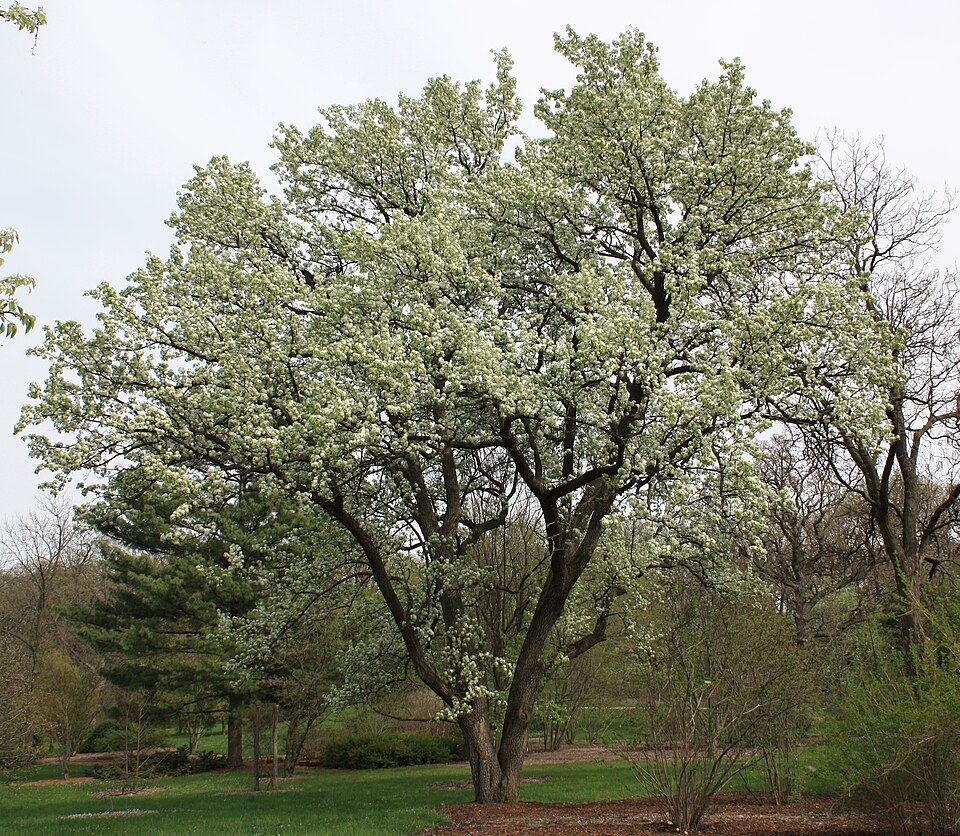
Callery (Bradford) Pear
Pyrus calleryana
Once planted everywhere for its uniform shape and early white bloom, the 'Bradford' pear is now infamous for splitting apart in storms due to its tight, included-bark unions, and is invasive across much of the eastern U.S. The flowers smell unpleasant, and seedlings form dense thorny thickets. Many states now discourage or ban it; choose native alternatives.
Field reference
Family
Rosaceae
Growth rate
Fast
Mature size
30–40 ft tall, 25–35 ft spread
Hardiness zone
5–9
Soil preference
Highly adaptable to most soils, pH, and urban conditions
Sun
Full sun
Pruning window
Late winter (dormant); structural pruning while young
Wood properties
Moderately hard wood (~0.56 SG) but with notoriously weak, tight-angled branch unions. Dense upright limbs with included bark fail readily — a classic storm-failure tree.
Native range
Native to China; widely planted and now invasive throughout the eastern United States
Green weight
52 lb/ft³
Pests & diseases to watch
Common questions
Why did my Bradford pear split apart in a storm?
Its many upright limbs crowd from nearly the same point with included bark, creating weak unions that fail under wind, ice, or age. Structural pruning helps, but the species is inherently failure-prone.
Should I replace my Callery pear?
Often yes — it is invasive in many regions and structurally short-lived. Consider native alternatives like serviceberry, redbud, or fringe tree for similar spring interest without the liabilities.
Related species in Rosaceae
Tree Nerd Academy
Ready to sit the ISA Certified Arborist exam?
Video curriculum, flashcards, and exam-sim built by working arborists.