
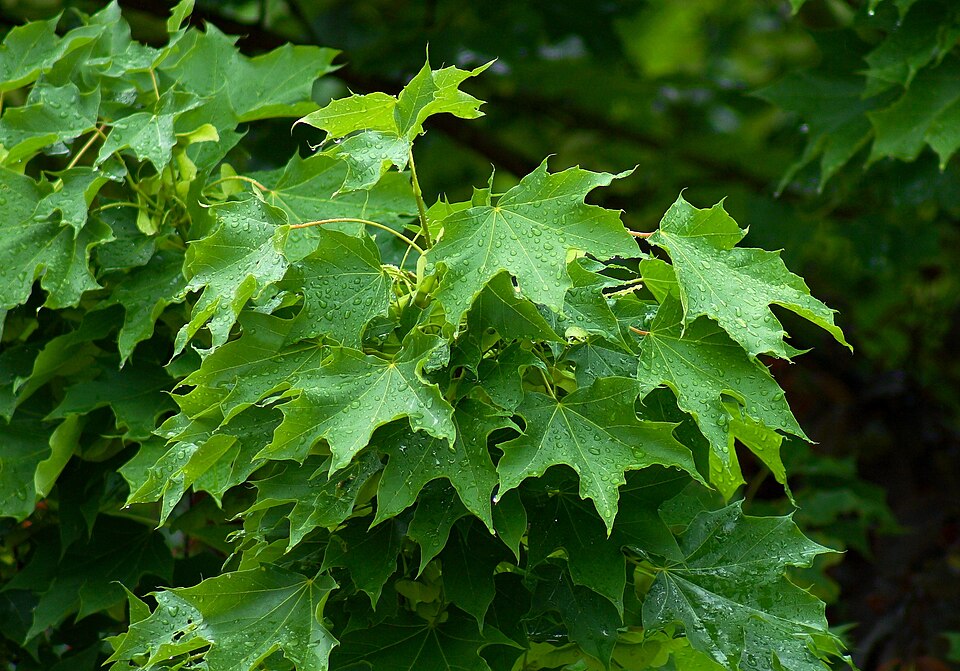
Norway Maple
Acer platanoides
A tough, pollution-tolerant European maple once planted heavily as a street tree, now considered invasive across much of the Northeast and Midwest. Casts dense shade that suppresses turf and natives, and girdling roots are common. Milky sap exudes from cut petioles, a quick ID trait.
Field reference
Family
Sapindaceae
Growth rate
Moderate
Mature size
40–60 ft tall, 35–50 ft spread
Hardiness zone
4–7
Soil preference
Highly adaptable, including compacted urban soils
Sun
Full sun to part shade
Pruning window
Summer (after leaf-out) to limit milky sap bleed
Wood properties
Hard, fairly dense diffuse-porous wood (~0.56 SG). Sound limbs, but dense, shallow root mass and girdling roots are the bigger management concern.
Native range
Native to Europe and western Asia; naturalized (invasive) in North America
Green weight
50 lb/ft³
Pests & diseases to watch
Common questions
How do I tell Norway maple from sugar maple?
Snap a leaf petiole — Norway maple oozes milky white sap, sugar maple runs clear. Norway maple leaves are also broader with more pointed lobes.
Should I plant a Norway maple?
Generally no. It is invasive in many regions and forms girdling roots and dense shade. Choose a native maple or a non-invasive alternative instead.
Related species in Sapindaceae
Tree Nerd Academy
Ready to sit the ISA Certified Arborist exam?
Video curriculum, flashcards, and exam-sim built by working arborists.