
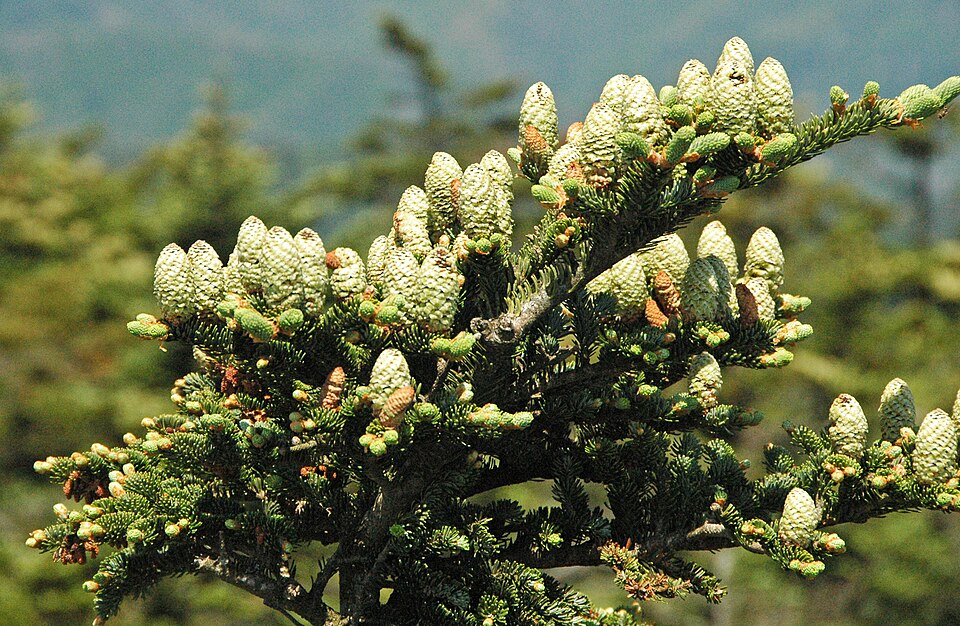
Fraser Fir
Abies fraseri
America's premier Christmas tree, native only to high Southern Appalachian peaks, with fragrant soft needles silver beneath. Heat- and drought-sensitive at low elevations, and wild stands have been devastated by the balsam woolly adelgid.
Field reference
Family
Pinaceae
Growth rate
Slow
Mature size
30–50 ft tall, 20–25 ft spread
Hardiness zone
4–7
Soil preference
Moist, acidic, well-drained high-elevation soils; intolerant of heat and heavy clay
Sun
Full sun to part shade
Pruning window
Late dormant season; shearing for form done in early summer on farms
Wood properties
Light, soft fir wood (~0.37 SG) of low structural value. Fragrant, flexible branches; primarily a Christmas-tree and ornamental species rather than a rigging tree.
Native range
Endemic to high elevations of the Southern Appalachians (NC, TN, VA)
Green weight
36 lb/ft³
Pests & diseases to watch
Common questions
Why does Fraser fir struggle in my lowland yard?
It is a high-elevation mountain species adapted to cool, moist, acidic sites. In hot lowland heat and heavy soil it suffers root rot and decline, so it rarely thrives far below its native range.
What makes Fraser fir the favorite Christmas tree?
Its soft, fragrant, blunt needles hold for weeks after cutting, and the sturdy, well-spaced branches carry ornaments well — qualities that make it the dominant cut-tree species in much of the U.S.
Related species in Pinaceae
Tree Nerd Academy
Ready to sit the ISA Certified Arborist exam?
Video curriculum, flashcards, and exam-sim built by working arborists.