
Reading a Tree's Architecture Before You Climb
Before you tie in, the tree has already told you how it wants to be climbed. Learn to read branch unions, lean, and load paths from the ground.
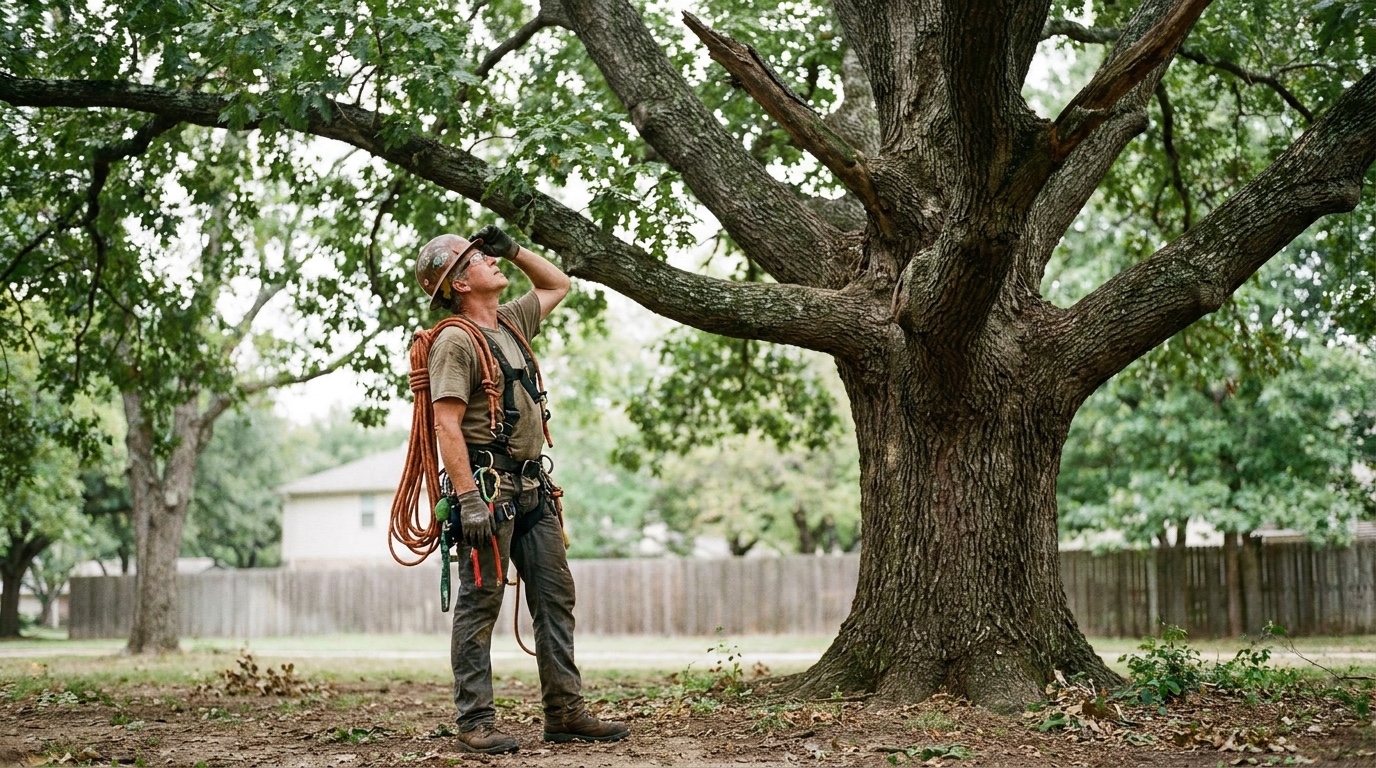
The best climbers make their hardest decisions before their feet leave the ground. A walk-around isn't a formality — it's where you decide whether the tree is climbable, where your anchor lives, and which limbs you trust with your life. Architecture is the language the tree uses to tell you all of that.
Start with the whole, then narrow
Stand back far enough to see the full crown against the sky. You're looking for the structural skeleton: the main stem, the scaffold limbs, and how load is distributed through them. Trees that grew in the open carry weight on broad, low scaffolds. Forest-grown trees that were later released — a remnant left after a lot was cleared — often carry a tall, slender stem with a top-heavy crown and weak, narrow unions. Same species, completely different climb.
Note the lean. A little lean is normal; reaction wood handles it. What you care about is recent lean — a root plate lifting on the tension side, a crack in the soil, or a stem that bends and then corrects (a "banana" trunk) which tells you the load path is already compensating for something.
Read the unions
Branch unions are where climbers get hurt. The detail that matters most is the branch bark ridge:
- A raised, pushed-out ridge of bark means the branch and stem are properly joined — strong wood, good attachment.
- Bark that is swallowed inward, with a seam pinched between two stems, is included bark. There's no wood continuity across that union. Codominant stems with included bark are among the most common catastrophic failures in the field.
Codominant leaders — two stems of roughly equal diameter competing for apical dominance — deserve real suspicion, especially when you see that pinched seam. Don't anchor above one and load it laterally.
Trace the load path of every limb you'll use
For each tie-in point and work-positioning limb, ask three questions:
- Where does this limb's weight want to go if it fails? Picture the swing. That arc is your strike zone and your groundie's, too.
- What's holding it on? Diameter at the union, the ridge, and the presence of decay or cavities right at the attachment.
- What am I adding to it? Your body weight, your rigging, and any shock load from a slip or a cut.
The 2:1 rule of thumb, and why it's only a start
A tie-in point ideally has a diameter at least twice the diameter of any limb you're suspending below it, and lives close to the stem rather than out on a lever arm. But diameter lies when there's decay. A sound-looking 10-inch limb hollowed to a shell can be weaker than a solid 5-inch one.
Sound it, look for the tells
Decay rarely hides completely. Watch for:
- Fruiting bodies (conks, brackets) — visible decay fungi mean the column is already advanced. Ganoderma at the base, Inonotus on the stem: assume significant internal loss.
- Cavities, seams, and old pruning wounds that never closed.
- Sap flow, cracks, ribbing, and bulges — the tree laying down extra wood to compensate for a weak spot underneath.
- A dull thud instead of a sharp ring when you sound the stem with a mallet.
Build the plan before the climb
By the time you flake out your line you should be able to say, out loud, where you're tying in, which limbs are off-limits, where the hazards are, and what your bail-out is if the tree behaves differently than you read it. If you can't, the tree isn't telling you it's unclimbable — it's telling you that you need a different system: a crane, an aerial lift, or a rigging-from-the-ground removal.
Reading architecture is a skill that compounds. Every tree you climb teaches you what the warning signs felt like once you were up there. Keep a mental library, and trust the ground read.
Tools referenced in this article
FAQ
What's the single most important thing to check before climbing?
Does a lean automatically mean a tree is dangerous?
Video curriculum, flashcards, and exam-sim built by working arborists.