
ISA Certification: What the Exam Actually Tests
The ISA Certified Arborist exam isn't a climbing test. Here's the real domain breakdown, what trips people up, and how to study for it.
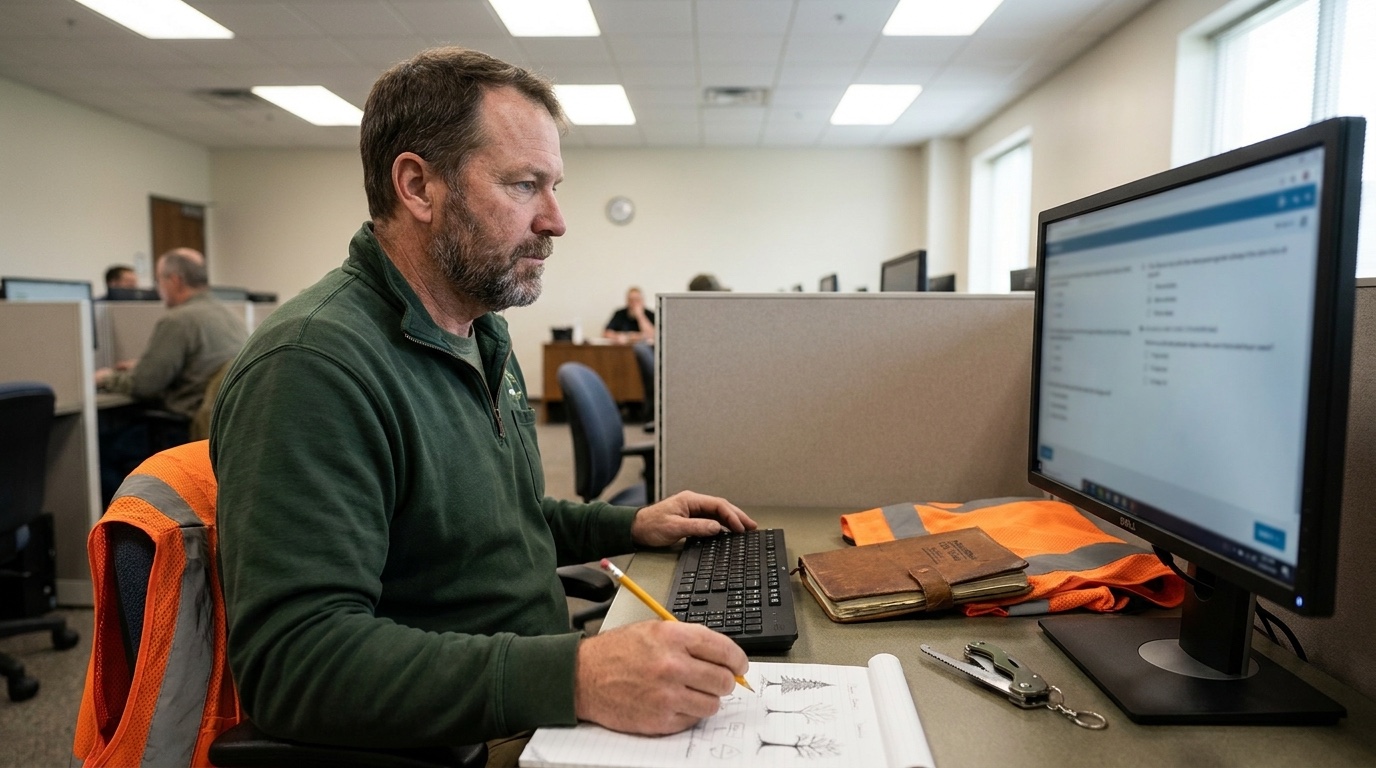
Plenty of strong climbers fail the ISA Certified Arborist exam, and plenty of people who've never thrown a line pass it. That surprises crews until they understand what the credential actually certifies: a broad, science-based command of how trees work and how to care for them — not how well you can swing.
What the credential is — and isn't
The ISA Certified Arborist certification verifies that you have foundational knowledge across the whole discipline of arboriculture and a minimum of experience in the field. It is not a skills test. There's no tree, no saw, no rope at the exam. It's a multiple-choice exam delivered at a testing center, drawn from a defined set of knowledge domains.
To sit for it you need eligibility — generally three years of full-time eligible practical experience, which a relevant degree can partially offset. Confirm the current requirements with ISA directly before you apply, because thresholds get updated.
The domains, in plain terms
The exam spreads questions across the core areas of tree care. Expect to be tested on:
- Tree biology — how trees grow, the vascular system, photosynthesis and respiration, CODIT and compartmentalization, response to wounding.
- Identification and selection — knowing taxa, growth habits, and right-tree-right-place.
- Soil management — soil structure, texture, compaction, drainage, the rhizosphere, and how roots actually function.
- Water management — tree water needs, irrigation, drought response.
- Nutrient management — fertilization principles, deficiencies, and not over-applying.
- Pruning — proper cuts, dose, timing, branch collar and bark ridge, why topping is malpractice.
- Diagnosis and treatment — a systematic approach to pests, diseases, and abiotic disorders.
- Tree protection — construction damage, root zones, preservation during development.
- Installation and establishment — planting depth, root flare, staking, aftercare.
- Climbing, safety, and work practices — including the relevant safety standards and electrical hazard awareness.
- Urban forestry — the tree in its built context.
The weighting shifts over time, but the heavy hitters are consistently biology, soils, diagnosis, and pruning. If those four are solid, you're most of the way there.
Where candidates trip
Three patterns show up again and again:
- Field shortcuts that aren't textbook-correct. The exam wants the science, not how your crew has always done it. "Paint the cut," "flush is cleaner," "spike the pruning job" — wrong answers, even if you've seen them on jobs.
- Soils and roots. Climbers tend to be strong on the canopy and weak below grade. Compaction, texture vs. structure, gas exchange in the root zone — study it deliberately.
- Reading the question. Many items hinge on one word — most, least, first, except. Slow down.
How to study
- Get the source material. The ISA Certification Study Guide and the Arborists' Certification Study Guide are written for this exam. Work through them, not random internet summaries.
- Drill biology and soils until they're reflexes. These are the topics you can't fake from field experience.
- Use the glossary as a checklist. If you can't define a term cleanly, that's a gap.
- Do practice questions to learn the question style, then go back to the book for anything you miss — don't just memorize answers.
- Connect it to your work. When you do a removal, name the failure. When you prune, name the cut and the dose. The knowledge sticks far better when it's tied to a tree you actually touched.
After you pass
The certification isn't a finish line — it carries a CEU requirement to keep it current. That's by design: arboriculture moves, and the credential is supposed to mean you've kept up. Plan your continuing education from day one rather than scrambling before your cycle closes.
Bottom line: study like a botanist and a soil scientist, not like a climber. The rope skills got you eligible. The book gets you certified.
FAQ
Is the ISA Certified Arborist exam a climbing test?
What do most people underestimate on the exam?
Video curriculum, flashcards, and exam-sim built by working arborists.