
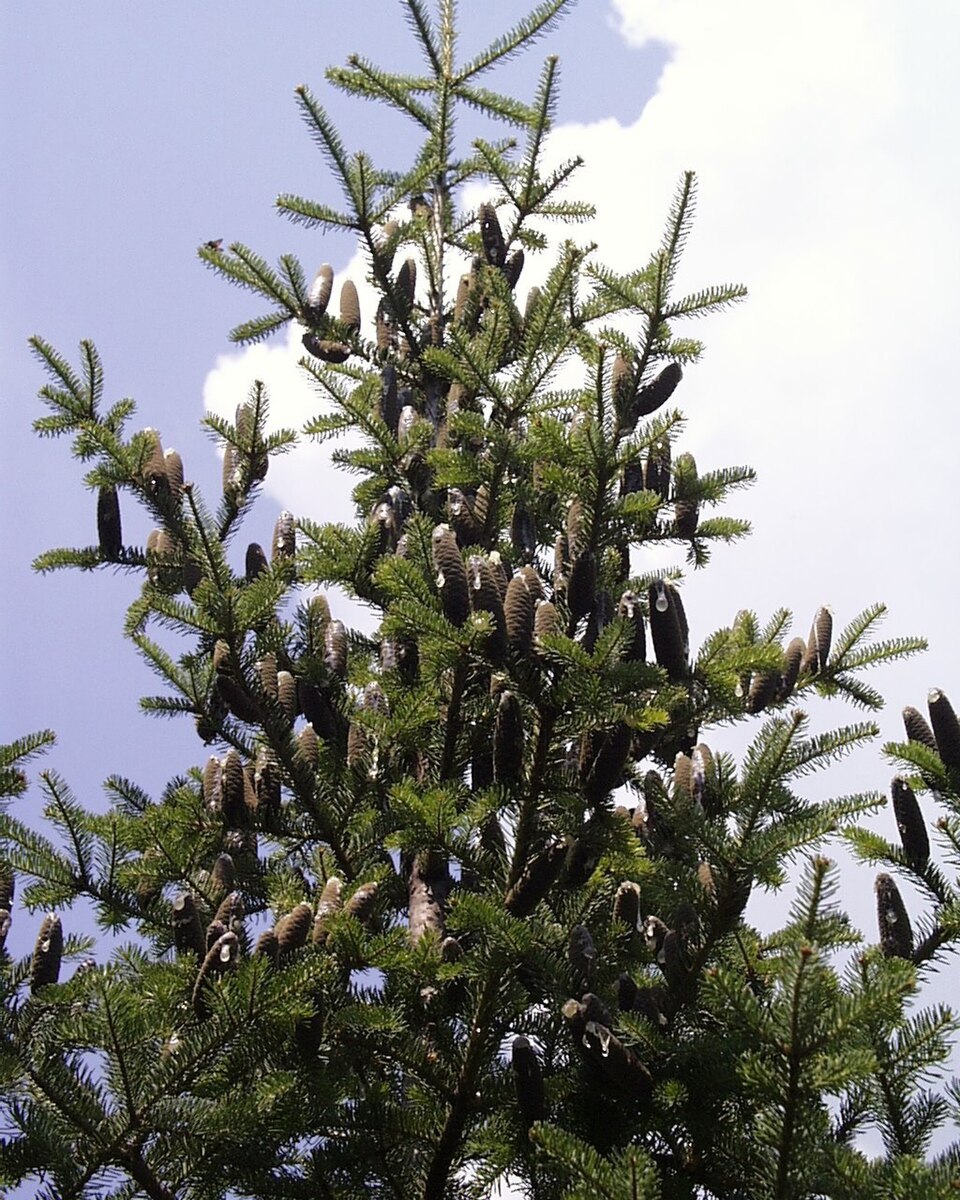
Balsam Fir
Abies balsamea
The classic fragrant northern Christmas tree and a key boreal conifer, with flat, aromatic needles and smooth gray bark studded with resin blisters that exude 'Canada balsam.' Shallow-rooted and short-lived, sensitive to heat and drought, and a primary host of the spruce budworm and balsam woolly adelgid.
Field reference
Family
Pinaceae
Growth rate
Slow
Mature size
40–60 ft tall, 15–25 ft spread
Hardiness zone
3–6
Soil preference
Cool, moist, acidic soils; shallow-rooted and intolerant of heat and drought
Sun
Full sun to part shade
Pruning window
Late dormant season; shear in early summer for Christmas-tree form
Wood properties
Light, soft, low-density fir wood used mainly for pulp. Fragrant, flexible needles; resin blisters on smooth bark yield Canada balsam — but weak, shallow roots mean windthrow risk.
Native range
Boreal and northeastern North America, from Alberta east to Newfoundland and south to the Appalachians
Green weight
36 lb/ft³
Common questions
Why is balsam fir such a popular Christmas tree?
Its dark green, flat, soft needles hold well after cutting and give off the quintessential 'Christmas tree' fragrance, making it one of the most traditional and aromatic cut trees in the Northeast.
What are the blisters on a balsam fir's bark?
Smooth balsam fir bark is dotted with resin-filled blisters that exude Canada balsam, historically used as a clear optical cement and varnish. Popping one releases the sticky, fragrant resin.
Related species in Pinaceae
Tree Nerd Academy
Ready to sit the ISA Certified Arborist exam?
Video curriculum, flashcards, and exam-sim built by working arborists.